



of surveyed life sciences executives expect AI to play a central role in driving major change in their organisations in 2026.
Source: Deloitte Life Sciences Outlook 2026Apply AI across Pharma & Life Sciences with real impact.
From R&D and clinical development to regulatory, medical affairs, pharmacovigilance, quality, manufacturing and AI agents: we help life sciences organisations identify relevant use cases, enable their people and bring AI responsibly into real workflows.

From scientific information work to controlled AI workflows in regulated processes.
of surveyed life sciences leaders say their organisations have successfully scaled AI. Only 9% report significant returns.
Source: Deloitte 2026joint guiding principles from EMA and FDA define a foundation for Good AI Practice in drug development.
Source: EMA & FDAAI can support the full medicinal product lifecycle.
EMA and Swissmedic do not treat AI as an isolated tool topic. Applications can span discovery and clinical development through manufacturing, regulatory processes and post-authorisation. The specific context of use is what matters.
01
Research & Discovery
Scientific intelligence, literature, target and molecule knowledge, hypotheses and knowledge access.
02
Clinical Development
Study design, trial operations, protocols, documentation and study knowledge.
03
Regulatory Affairs
Submission content, document comparison, regulatory intelligence and medical writing.
04
Medical Affairs
Scientific exchange, MSL support, medical information and evidence synthesis.
05
Safety & Pharmacovigilance
Case preparation, signal support, literature and structured safety information.
06
Quality & Manufacturing
SOP knowledge, deviations, CAPA, process knowledge, training and manufacturing support.
From information work to controlled AI workflows.
The strongest use cases combine high manual effort with clear data sources, reviewable outputs and defined human oversight. In regulated areas, governance needs to be part of the design from the start.
R&D & Scientific Intelligence
High potential
Scientific & Literature Intelligence
Problem
Scientific knowledge is spread across publications, internal documents, studies and data sources.
AI Approach
AI searches approved sources, synthesises evidence, compares publications and supports structured research questions.
Business Value
Faster access to relevant knowledge and more time for scientific interpretation.
Clinical Development
High potential
Clinical Trial Copilot
Problem
Study teams work with large volumes of protocols, status information, communications and trial documentation.
AI Approach
AI summarises information, supports study-team queries, creates first drafts and helps surface operational risks or open points.
Business Value
Less administrative effort and faster preparation of trial decisions.
Regulatory & Medical Writing
High potential
Regulatory Writing Assistant
Problem
Regulatory documents require extensive research, reuse of approved content, consistency checks and review.
AI Approach
AI prepares controlled first drafts, compares documents, finds relevant sources and supports structured review processes.
Business Value
Faster document preparation with clear expert approval and traceability.
Medical Affairs
Human in the loop
Medical Information & MSL Assistant
Problem
Medical teams need to process scientific questions, publications and insights efficiently without compromising scientific accuracy.
AI Approach
AI structures requests, synthesises approved evidence, drafts responses and consolidates MSL insights.
Business Value
Faster preparation of scientific communication and more time for high-value interactions.
Drug Safety
Controlled workflow
Pharmacovigilance & Safety Support
Problem
Safety teams process large volumes of structured and unstructured information, literature and case context.
AI Approach
AI supports extraction, summarisation, classification and preparation of defined review steps.
Business Value
More efficient case preparation with clear human accountability and quality control.
Quality & Knowledge
Foundational
GxP & SOP Knowledge Assistant
Problem
SOPs, work instructions, policies and quality knowledge are often distributed across systems and documents.
AI Approach
A controlled knowledge assistant answers questions using approved content and shows sources transparently.
Business Value
Faster access to knowledge, more consistent answers and fewer recurring internal questions.
Manufacturing & Quality
High potential
Deviation & CAPA Assistant
Problem
Deviation investigations and CAPA processes require research across historical cases, SOPs, equipment and process data.
AI Approach
AI helps find relevant information, summarise similar cases and prepare structured initial analyses.
Business Value
Faster investigation preparation without automating professional assessment or approval.
Agents & Automation
Emerging
AI Agents for Life Sciences Workflows
Problem
Many processes involve recurring steps across documents, knowledge sources, systems and multiple functions.
AI Approach
Agents orchestrate defined tasks, retrieve information, create drafts, check prerequisites and hand results to specialists.
Business Value
Fewer manual handovers and better orchestrated processes with clear control points.
In life sciences, AI needs a clear context of use.
EMA, FDA and Swissmedic emphasise a risk-based approach across the lifecycle. The closer AI gets to evidence generation, quality, safety or regulatory decision-making, the more important validation, data quality, documentation, human oversight and lifecycle management become.
Specific regulatory requirements depend on the use case, product, process, market and system involved. Our work does not replace legal, regulatory or GxP advice.
Context of Use
The role, purpose, boundaries and permitted use of the AI system should be clearly defined for the specific process.
Data Quality & Provenance
Data sources, quality, provenance, representativeness and potential bias should be appropriately addressed.
Validation & Performance
Validation and performance assessment should be proportionate to risk and intended use.
Human Oversight
Review, approval and accountability remain with people where required by the process and risk profile.
GxP, Security & Privacy
Good Practices, privacy, cybersecurity, access rights and confidentiality need to be built into design and operation. AI Security Testing helps assess attack surfaces in chatbots and agents.
Lifecycle & Documentation
Models, prompts, data sources, changes and controls require appropriate documentation and ongoing monitoring.
Scientific and domain expertise remain essential. AI capability comes on top.
R&D, clinical, regulatory, medical, quality, safety, manufacturing and commercial teams use AI in different contexts. We therefore combine AI literacy with role-specific use cases, approved tools and your organisation's governance requirements.

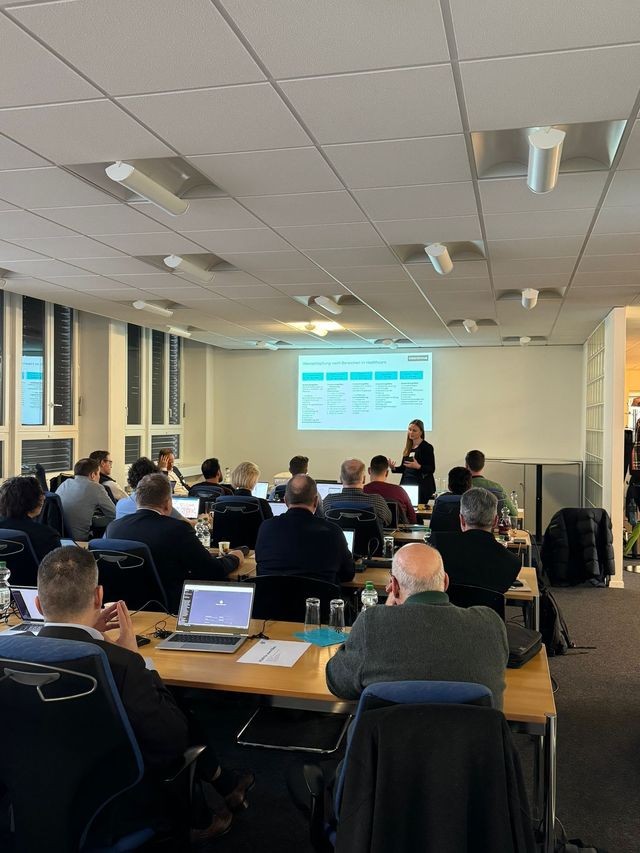
Role-based Enablement
01
AI Literacy & Responsible AI
Foundations, opportunities, limitations, data, risks and responsible use in regulated environments.
02
Role-specific Life Sciences Use Cases
Real tasks from R&D, clinical, regulatory, medical, quality, safety or manufacturing.
03
Tools, Prompting & Microsoft Copilot
Productive use of approved tools with practical exercises and safe ways of working.
04
Workflows & Agents
Move from individual prompts to repeatable workflows, knowledge assistants and agentic processes.
05
Adoption, Governance & Scale
Embed champions, standards, governance, measurement and continuous improvement.
From skills and use cases to governance and execution.
Depending on where you are today, we can start with enablement, a concrete use case, Microsoft Copilot or a strategic question. The goal is a pragmatic starting point that brings business value, risk and scalability together.
AI Enablement & Training
Role-based AI training with life sciences examples, real tasks and clear guardrails.
Corporate AI Training →AI Use Case Discovery
Identify use cases across the product lifecycle and prioritise them by value, feasibility, data readiness and risk.
AI Use Case Workshop →Microsoft Copilot
Readiness, governance, role-based use cases, training and adoption for safe productivity with Copilot.
Microsoft Copilot →AI Advisory & Governance
Shape strategy, operating model, AI governance, portfolio management and adoption for scalable use.
AI Advisory →AI Agents & Workflows
Prototype prioritised workflows, test feasibility and turn them into controlled AI assistants or agents.
Practical AI experience across pharma and healthcare.
Our experience spans AI enablement and prompting through use case discovery and transformation in regulated and knowledge-intensive organisations.
17'000+
people trained
150+
clients
Since 2019
AI Enablement & Transformation
AI Enablement & Practical Prompting
Practical insights into generative AI, prompting, model limitations and ethical considerations for employees in a pharmaceutical environment.
Spital Thurgau · KSW
Experience with organisations in healthcare and medical environments complements our work with life sciences companies.
Pharma Project Experience
The team's background includes previous project work in pharma at Bayer alongside long-standing AI product and transformation experience.
Customer logos from the current pharma page.
We integrated the visible client references from the existing page into the new layout.


mepha | teva
Pharma reference
Common questions about AI in pharma and life sciences.
Which AI use cases are particularly relevant in pharma and life sciences?
Relevant applications range from scientific intelligence, clinical development and regulatory writing to medical affairs, pharmacovigilance, quality, manufacturing, knowledge assistants and agentic workflows. The right use cases depend on business value, data, risk, validation needs and organisational readiness.
How can AI support regulatory affairs and medical writing?
AI can search approved content and sources, compare documents, prepare first drafts and support consistency checks. Expert review and approval remain central, particularly for regulatory content.
How can AI support medical affairs?
AI can structure scientific literature and approved evidence, prepare medical information requests, consolidate MSL insights and summarise scientific content. Scientific accuracy and human review are particularly important.
What role can AI play in clinical development?
AI can support study teams with information access, trial operations, documentation, protocol work and preparation of operational decisions. Applications that influence regulatory evidence require an appropriately controlled and risk-based approach.
Can AI be used in quality and GxP processes?
Yes, for example for access to SOP knowledge, preparation of deviation investigations or finding similar historical cases. The specific application needs to fit GxP requirements, validation, data integrity and the defined context of use.
What matters for AI governance in life sciences?
Important topics include context of use, data quality, provenance, validation, performance, human oversight, GxP, privacy, cybersecurity, documentation and lifecycle management.
Which AI skills do life sciences teams need?
Alongside domain expertise, AI literacy, safe use of approved tools, prompting, critical assessment of AI outputs and an understanding of data, risk, sources and human oversight are becoming increasingly important.
How should a pharma company get started with AI?
A practical starting point combines clear business goals with a prioritised set of concrete use cases. Data, regulatory context, skills, governance and technical conditions should be assessed in parallel. Not every use case needs to become fully automated or production-ready immediately.
Where can AI create the greatest value in your life sciences organisation?
Tell us briefly where you are today. We will help you assess relevant use cases, capability needs, governance questions and the right next step.

Nina Habicht
Founder & CEO · Dreamleap
Book an Intro Call